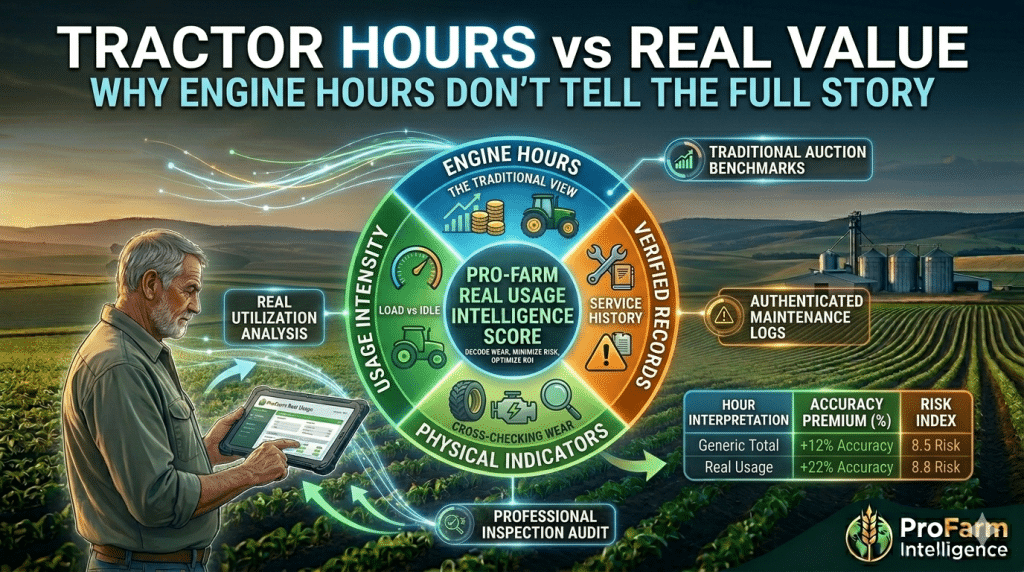
Engine hours are one of the most commonly referenced metrics in agricultural equipment valuation. In South Africa’s used machinery market, they are often treated as the primary indicator of condition and resale value.
That approach is incomplete—and in many cases misleading.
A tractor with “low hours” can still carry significant hidden wear, while a higher-hour machine may outperform expectations if it has been maintained correctly and operated under low-stress conditions.
This article breaks down why tractor hours value in South Africa cannot be interpreted in isolation, and how professional buyers evaluate true machine value using multi-variable analysis.
What Engine Hours Actually Measure
Engine hours represent the cumulative time a tractor’s engine has been running. On paper, this seems like a straightforward proxy for usage.
However, engine hours do not distinguish between:
- Idle operation (low stress)
- Light field work (moderate stress)
- Heavy-duty towing or ploughing (high stress)
This distinction is critical.
Two tractors with identical engine hours may have experienced completely different levels of mechanical stress depending on how they were used.
Key limitation:
Engine hours measure time, not load intensity.
That is the fundamental gap in traditional valuation thinking.
Why Engine Hours Are Misleading
1. Idle Hours Distort True Usage
A tractor used frequently for stationary tasks (e.g., generator work, light transport, loading operations) may accumulate hours without meaningful mechanical wear.
Conversely, field-intensive operations create significantly more strain per hour.
Result:
- Low wear ≠ low hours
- High hours ≠ high wear
2. Hour Meter Integrity Is Not Guaranteed
In some cases:
- Hour meters are replaced during repairs
- Displays are reset after electrical faults
- Components are swapped between units
While not always intentional, this introduces uncertainty into valuation models.
3. Operator Behaviour Differences
Two machines of the same model and hours can differ drastically based on:
- Driving style
- Load management
- Maintenance discipline
- Warm-up and cool-down practices
Aggressive operation significantly accelerates wear regardless of hours.
4. Lack of Load-Weighted Measurement
Modern tractors often lack a system that records:
- Torque load exposure
- Hydraulic strain cycles
- Transmission stress events
Without this, engine hours remain a non-weighted metric.
The Concept of Usage Intensity
To understand real tractor value, professionals focus on usage intensity, not just duration.
Usage intensity refers to the mechanical stress experienced per hour of operation.
Key components of usage intensity:
1. Load Cycles
- Frequency of heavy pulling or towing
- Implement resistance levels
- Field density and soil conditions
2. Torque Stress Exposure
- Engine strain under load
- Frequency of high RPM operation
- Work requiring sustained power output
3. Hydraulic System Usage
- Loader frequency
- Lift cycles per operation
- Pressure system load repetition
4. Terrain and Application Type
- Flat land vs steep or uneven terrain
- Dryland farming vs irrigated systems
- Transport vs field operations
Usage intensity is often a stronger predictor of wear than engine hours alone.
Physical Wear Indicators That Matter More Than Hours
Professional inspectors rely heavily on physical diagnostics because they reveal cumulative stress.
1. Pedals and Controls
- Excessive wear indicates frequent use
- Smooth but worn pedals suggest high operational cycles
2. Steering System Play
- Increased looseness suggests front-end wear
- Often linked to heavy field use or poor maintenance
3. Seat and Cab Compression
- Seat deformation indicates long operational exposure
- Cab vibration damage suggests structural fatigue
4. Hydraulic Response Time
- Slow or inconsistent lift performance indicates system degradation
- Often independent of recorded engine hours
5. Gearbox Smoothness
- Hard shifting or grinding indicates internal wear
- Strong indicator of load intensity history
Engine Hours vs Maintenance Reality
Maintenance history is often more important than engine hours themselves.
Key insight:
A well-maintained high-hour tractor can outperform a poorly maintained low-hour machine.
Why maintenance matters:
- Oil quality prevents internal wear
- Filter replacement protects hydraulic systems
- Cooling system maintenance prevents engine stress
- Transmission servicing extends gearbox life
Neglected maintenance accelerates degradation regardless of usage time.
Why Engine Hours Still Dominate Market Thinking
Despite their limitations, engine hours remain widely used because they are:
- Easy to measure
- Standardised across listings
- Universally understood by buyers
- Used in auction catalogues
They serve as a baseline comparison tool, not a complete valuation model.
Professional buyers do not discard hours—they contextualise them.
Real Valuation Model: Multi-Factor Approach
To accurately assess tractor value in South Africa, professionals use a layered model:
1. Engine Hours (Baseline Metric)
Provides a starting reference point, not a final value.
2. Usage Intensity Factor
Adjusts valuation based on mechanical stress exposure.
3. Condition Grading
Assesses:
- Structural integrity
- Hydraulic performance
- Engine behaviour
- Wear consistency
4. Maintenance Quality Index
Evaluates:
- Service consistency
- Part replacement history
- Repair quality standards
5. Market Demand Adjustment
Reflects:
- Seasonal demand cycles
- Regional agricultural needs
- Inventory availability
Final valuation is the combined output of all five variables—not a single metric.
Common Mistakes Buyers Make
1. Overvaluing Low-Hour Machines
Low hours without context often lead to overpayment for poorly maintained equipment.
2. Ignoring Load History
Not all hours are equal. Heavy-duty hours degrade equipment faster than light-use hours.
3. Failing to Inspect Beyond the Meter
Relying solely on dashboard readings ignores mechanical reality.
4. Overlooking Maintenance Records
Missing service history increases uncertainty and reduces accurate valuation capability.
Practical Framework: How to Assess Real Tractor Value
A structured approach improves accuracy significantly:
Step 1: Verify Engine Hours
Use as a reference point, not a conclusion.
Step 2: Inspect Physical Wear Patterns
Evaluate pedals, hydraulics, steering, and transmission response.
Step 3: Review Maintenance History
Check for consistency and quality of servicing.
Step 4: Determine Usage Context
Identify whether the machine was used for:
- Light utility work
- Heavy field operations
- Mixed workload environments
Step 5: Benchmark Against Market Data
Compare with similar machines in:
- Condition
- Hours range
- Regional demand
FAQ
Are tractor hours accurate for valuation?
They are partially useful but incomplete. Hours must be combined with condition, maintenance, and usage intensity for accurate valuation.
What is considered high hours for a tractor?
It depends on category and maintenance quality, but hours alone should never be used as a standalone threshold.
Can engine hours be reset or changed?
In some cases, yes. This is why physical inspection and service history verification are essential.
What matters more: age or hours?
Hours generally matter more than age, but condition and maintenance history often outweigh both.
Final Insight
Engine hours are a useful reference point—but they are not a valuation system.
True tractor value in South Africa is determined by a combination of:
- Mechanical condition
- Usage intensity
- Maintenance discipline
- Market demand
Once these factors are considered together, valuation becomes significantly more accurate and less speculative.
In professional equipment markets, hours tell you how long a machine has run—but not how hard it has worked.