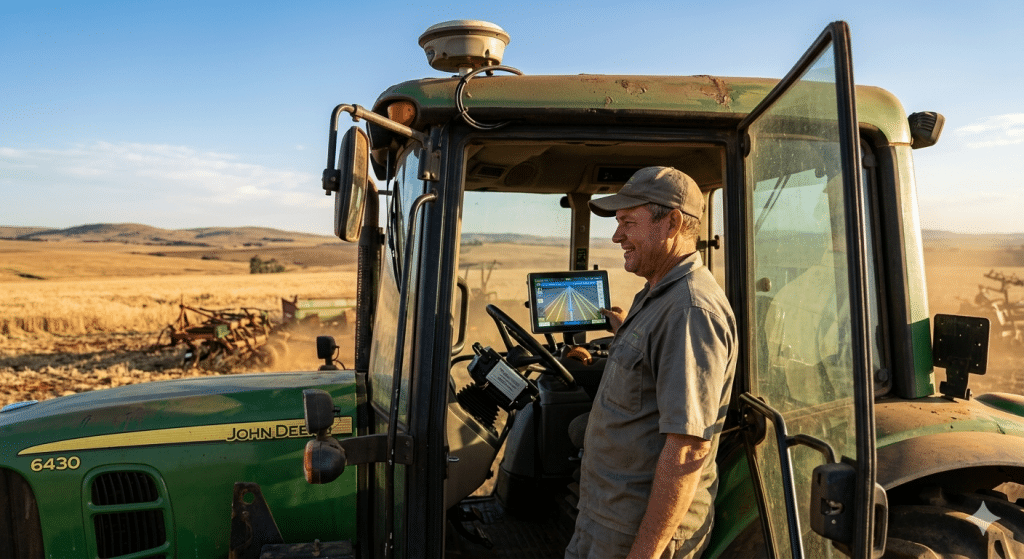
Meet Johan, a wheat producer in the Swartland. Like many commercial farmers in South Africa, he faces the constant pressure of shrinking margins, rising diesel costs, and the need to maximise every drop of expensive fertiliser. When Johan evaluated his mechanisation strategy for 2026, the local dealership pushed a brand-new, tech-heavy tractor with a price tag approaching R4 million. But Johan, focused on maintaining his farm’s cash flow, chose a different path: putting new brains into old iron.
Johan bought a meticulously maintained, 10-year-old pre-owned tractor and spent a fraction of the cost to retrofit it with cutting-edge auto-steer and precision agriculture technology.
In 2026, the reality is clear: you don’t need to take on the massive debt of a brand-new model to get cutting-edge precision capabilities. The global trend towards retrofitting is booming, especially in regions like ours where older machinery dominates. Here is how you can upgrade your pre-owned tractor, reduce input overlap, and significantly boost your farm’s profitability.
The Core Upgrades: What Can You Retrofit?
When looking to modernize a pre-owned tractor, you don’t need to completely rebuild the machine. The core of precision agriculture lies in three key components that can be fitted to almost any reliable tractor.
1. Auto-Steer Systems
Auto-steer is the foundation of precision farming, designed to guide the tractor accurately along predefined paths. There are two main ways to retrofit this:
- Electric Steering Wheel Motors: This is the most common and cost-effective aftermarket solution. A motorised gear is attached directly to the steering column, taking over the physical turning of the wheel based on GPS data.
- Integrated Hydraulic Valves: If you are buying a slightly newer pre-owned tractor (e.g., 2014-2018), it may already be “auto-steer ready.” In this case, the system connects directly to the tractor’s hydraulic steering block, providing a smoother, more seamless operation than external steering wheel motors.
2. GPS/GNSS Receivers
To steer accurately, your tractor needs to know exactly where it is. High-precision GNSS (Global Navigation Satellite System) receivers are mounted on the roof of the cab. In 2026, these receivers utilize RTK (Real-Time Kinematic) networks, offering sub-inch, repeatable accuracy. This means your tractor can follow the exact same tracks for planting, spraying, and harvesting year after year, minimising soil compaction.
3. Universal ISOBUS Terminals
The terminal is the brain inside the cab—the screen where the operator controls everything. Modern aftermarket terminals, such as those from Trimble, Ag Leader, or John Deere GreenStar, are ISOBUS compatible. This means a single monitor can control not only the auto-steer but also communicate with modern implements like planters and sprayers to control variable-rate fertiliser applications and seed drop.
Cost vs. Benefit Analysis: The ROI of Retrofitting
The global market for agricultural autopilot systems is expanding rapidly precisely because the return on investment (ROI) is so compelling.
Let’s look at the financial realities. Buying a brand-new, 150kW tractor with factory-installed precision tech will easily cost upwards of R3.5 million to R4 million.
Conversely, you could purchase a mechanically sound, 2015 model pre-owned tractor for roughly R1.2 million. Adding a comprehensive aftermarket auto-steer and telematics kit will cost approximately R100,000 to R150,000, depending on the brand and RTK unlock levels.
Where do the savings come from?
- Eliminating Overlap: Without auto-steer, human error naturally causes 5% to 10% overlap during planting, spraying, and tillage. Auto-steer eliminates this, instantly reducing your seed, diesel, and fertiliser bills.
- Reduced Driver Fatigue: Operators can focus on implement performance rather than constantly correcting the steering wheel, reducing errors and allowing for longer, safer working hours during critical planting windows.
- Variable Rate Application: By integrating the retrofit terminal with a modern implement, you can ensure that fertiliser is only applied where it is needed based on soil maps, heavily reducing chemical wastage.
Choosing the Right Pre-Owned Tractor for Retrofitting
Not all old iron is created equal. If you are browsing the pre-owned market with the specific intention of retrofitting precision technology, keep these key factors in mind:
- Is it “Auto-Steer Ready”? Check the specifications. Many tractors built between 2014 and 2018 came off the factory line with the wiring harnesses and hydraulic valves already installed, even if the original owner didn’t buy the monitor and receiver. This makes retrofitting much cheaper and easier.
- Cab Space and Layout: Precision farming requires screens. Ensure the cab of the used tractor has sufficient mounting points and visibility so that adding a 10-inch terminal doesn’t block the driver’s view of the field.
- Electrical and Alternator Capacity: Modern precision technology requires reliable, clean power. Check that the older tractor’s alternator can handle the extra electrical load of monitors, steering motors, and modern implement control modules.
- Mechanical Integrity: Putting new brains into a broken machine is a bad investment. Ensure the tractor’s transmission and hydraulics are in top condition before investing in digital upgrades.
Conclusion
In an era of rising input costs and tight margins, commercial farmers must find ways to increase efficiency without over-capitalising. Retrofitting a reliable, pre-owned tractor with modern auto-steer and telematics gives you the best of both worlds: the cost-savings of used machinery and the input-saving precision of a 2026 model.
By eliminating overlap, reducing fuel consumption, and optimising your fertiliser usage, an aftermarket precision kit pays for itself incredibly quickly.
Are you looking for the perfect “blank canvas” for your precision upgrades? Browse the extensive selection of vetted, mechanically sound pre-owned tractors on ProFarm Intelligence today. Find the reliable power you need, and start farming smarter, not harder.