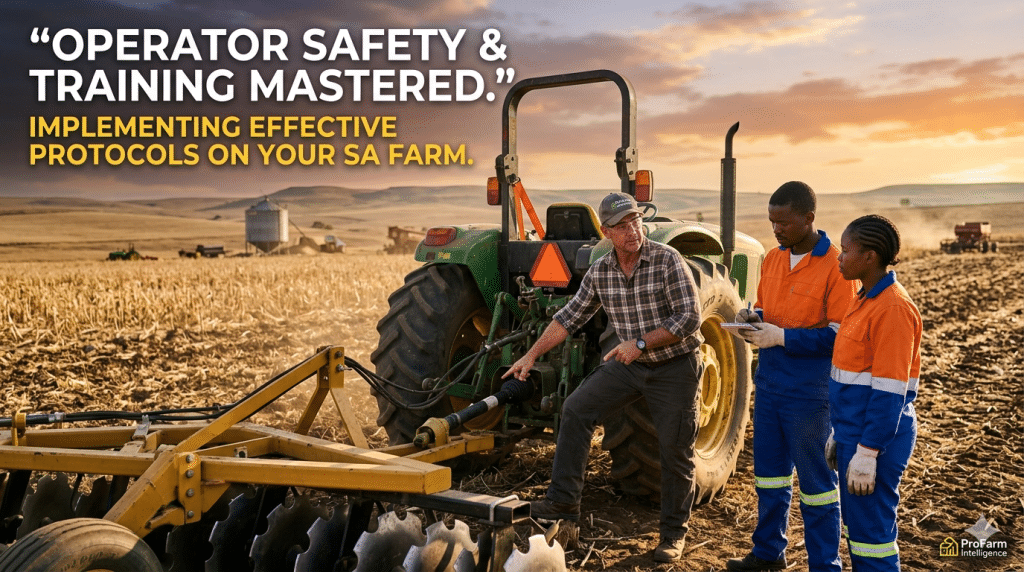
Francois, a farm manager near Bethlehem in the Free State, remembers the cold sweat like it was yesterday. During a particularly busy planting season, running the farm’s reliable but aging 2012 primary tractor, a newly hired operator narrowly avoided catastrophic injury. He had stepped off the moving tractor to adjust a clogged planter hydraulic line, momentarily forgetting that the Power Take-Off (PTO) was still engaged. A loose flap on his overall was seconds away from being snagged by the dynamic shaft.
It wasn’t a failure of the analog machinery or the newly retrofitted auto-steer system Francois had installed (the topic of our last ProFarm Intelligence guide). It was a breakdown in fundamental safety training.
A tractor license in South Africa confirms legal competency on a public road, but it does not guarantee operational competency in a high-risk field environment. Farm accidents carry an immense human toll, but they also bring significant financial costs through equipment downtime, expensive ZAR repairs, and potential legal liability. Effective operator training is not a regulatory burden; it is a critical investment in your farm’s productivity and resilience.
Here is a practical guide for South African farm managers on implementing robust tractor and machinery safety training protocols.
Developing a Safety-First Culture: The Manager’s Role
Safety protocols are only effective if they are respected. A “Safety-First” culture must originate directly from the farm management level and be demonstrated daily.
1. Leading by Example
A farm manager who ignores seatbelt rules, operates machinery while fatigued, or rushes past lock-out procedures cannot expect operators to prioritize safety. Management must visibly follow every rule they implement. This includes using appropriate Personal Protective Equipment (PPE) when supervising maintenance, such as safety glasses or steel-toed boots, setting a standard that PPE is mandatory, not optional.
2. Regular Safety Meetings
Keep hazards top of mind. Implement short, frequent safety briefings—perhaps “Tailgate Safety Meetings” once a week before fieldwork begins. Use these to discuss specific seasonal risks (e.g., mud after heavy rains, high fire risk during harvest, or working near low-hanging electrical lines). These meetings create an open forum where operators can report near-misses or identify faulty machinery guards without fear of retribution.
Operator Training Protocols: Moving Beyond informal Supervision
Too often, operator “training” involves a quick overview of controls followed by immediate independent operation. A structured approach is essential.
1. Initial Competency Assessment
Before assigning any operator to machinery, conduct a practical competency test. Have them perform a pre-operation check, hitch an implement, back up a trailer, and demonstrate basic driving skills in a controlled area. This assessment helps you identify skill gaps before they become liabilities in the field.
2. Machine-Specific Training
Every piece of mechanisation has unique operational characteristics and risks.
- Unique Controls: Ensure operators understand specific hydraulic controls, transmission ranges, and four-wheel-drive engagement.
- Center of Gravity: Discuss the tractor’s stability limits, especially when running front-end loaders or working on steep Free State slopes.
- Retrofitted Technology: If you have retrofitted auto-steer or precision terminals on your pre-owned 2012 tractors (as discussed previously), operators must be trained specifically on both the older machinery and the digital interfaces. Confusion between manual and automated steering control can cause dangerous errors.
3. Supervised Operation and Phased Independence
Do not rush independence. New operators or those assigned to complex new tasks should work under close, experienced supervision until they consistently demonstrate safe operation. Gradually increase their autonomy as they build confidence and operational mastery.
Critical Safe Operating Practices: The Non-Negotiables
Your training must focus intensely on the highest-risk behaviors. These safe operating practices must be absolute non-negotiables on your farm.
1. The 15-Minute Pre-Operation Safety Walkaround
Before starting the engine, operators must perform a consistent safety inspection. neglected maintenance is a key cause of accidents on older pre-owned tractors.
- Tyres: Check inflation and looking for deep cuts.
- Lights: Verify headlights and flashing amber lights (essential for road travel).
- Hydraulics: Look for leaks or frayed hoses.
- Guards: Ensure all PTO shields and master guards are securely in place.
- Brakes: Perform a quick brake check before moving the machine.
2. The Dangers of Dynamic Components (PTO Safety)
Power Take-Off shafts rotate at incredible speeds (540 or 1,000 RPM) and are lethal. A significant percentage of farm fatalities are caused by PTO entanglement.
- Strict Protocol: Implement a mandatory “zero energy state” rule. The tractor engine must be shut off, the key removed, and the PTO completely disengaged before any operator approaches the hitch area, dynamic shafts, or implement components.
- Guard Integrity: Inspect PTO guards daily. Damaged or missing shields must be replaced immediately, before the machine can be used.
3. Stability, Speed, and Rollover Prevention
Tractor rollovers are the leading cause of fatal farm injuries. Preventative training is vital.
- Speed Control: Rushing is a primary cause of accidents. Impose strict speed limits, particularly on farm access roads, turns, and rough terrain.
- Slope Safety: Train operators on the proper techniques for working on slopes: keep heavy loads low to the ground, back up steep inclines, and avoid driving across a slope whenever possible. Understand how implement weight shifts the tractor’s center of gravity.
- Seatbelts Save Lives: If the tractor has a Roll-Over Protective Structure (ROPS), the seatbelt must always be worn. The ROPS cannot protect an operator who is thrown from the cab during a rollover.
Conclusion: The ROI of Safety
A commitment to comprehensive operator training delivers significant returns on investment. It directly translates to reduced accident rates, increased equipment uptime, and lower overall maintenance costs because well-trained operators treat reliable pre-owned machinery with greater care. Safety-first protocols enhance the long-term value of your fleet.
Small, structured investments in safety culture and rigorous operator training pay massive dividends, ensuring that every operator returns home safely at the end of the day.
Looking to expand your fleet with reliable mechanisation that makes training simpler and safer? Explore the wide range of vetted, mechanically sound pre-owned tractors and implements available on the ProFarm Intelligence marketplace today. Find the robust machinery you need to secure your farm’s future, backed by detailed operational history.