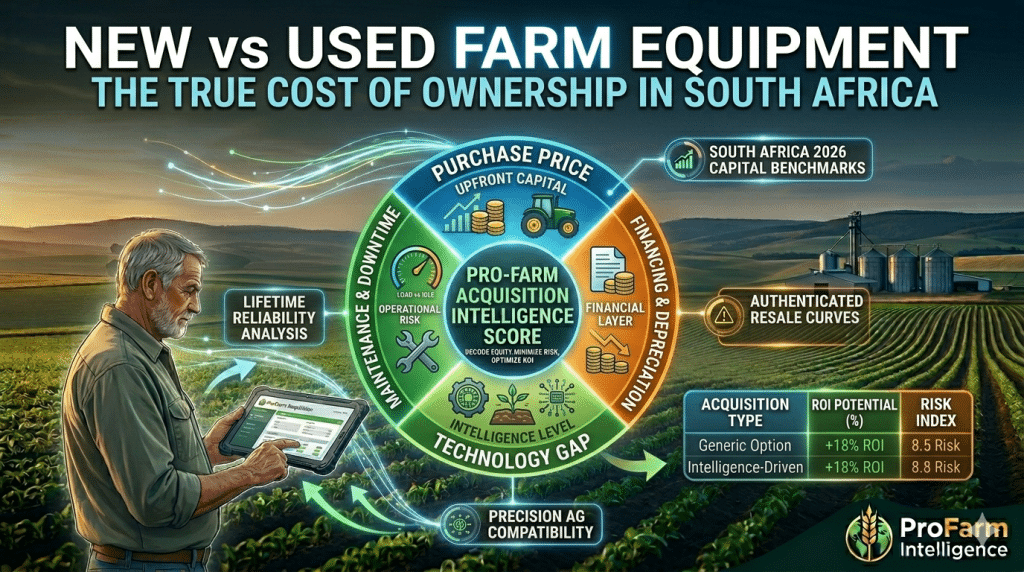
In agricultural equipment procurement, the most expensive decisions are rarely the most obvious ones. Farmers and operators often evaluate machinery based on purchase price, yet the real financial outcome is determined by total cost of ownership (TCO) over the asset lifecycle.
In South Africa’s agricultural environment—where input costs fluctuate, downtime carries high opportunity cost, and machinery utilisation is intensive—the decision between new and used equipment is not a preference question. It is a capital efficiency problem.
This guide breaks down the full cost structure behind new vs used farm equipment in South Africa, using a structured, decision-intelligence approach rather than intuition.
Why Purchase Price Is a Misleading Metric
The purchase price of agricultural equipment is only the entry point of a much larger financial system.
Focusing solely on upfront cost ignores:
- Depreciation behaviour
- Maintenance exposure
- Downtime risk
- Fuel efficiency differences
- Resale value recovery
Two machines with vastly different purchase prices can converge—or invert—over time when lifecycle costs are considered.
Key insight:
Affordability is not the same as efficiency.
A cheaper machine can become more expensive over time if operational costs escalate.
Total Cost of Ownership (TCO) Framework
A structured TCO model allows for objective comparison between new and used equipment.
1. Purchase Price
- Initial capital outlay
- Financing requirement (if applicable)
- Deposit and interest exposure
2. Depreciation Curve
- Rate at which asset loses value over time
- New equipment typically depreciates faster in early years
- Used equipment often stabilises in value decline
3. Maintenance and Repair Costs
- Scheduled servicing
- Unplanned mechanical failures
- Parts replacement cycles
- Labour and downtime costs
4. Fuel and Operational Efficiency
- Engine efficiency differences between generations
- Load efficiency under field conditions
- Fuel burn per hectare or hour
5. Downtime Cost
Often the most underestimated component:
- Lost production time
- Seasonal delay impact
- Labour inefficiency during breakdown periods
6. Resale Value Recovery
- Expected resale price at exit point
- Market liquidity of asset category
- Demand cycles affecting exit timing
New Farm Equipment: Cost Structure Analysis
New equipment is typically purchased for certainty and reliability rather than cost minimisation.
Advantages
1. Reliability and Predictability
- Minimal initial mechanical risk
- Manufacturer warranty coverage
- Lower probability of early-stage failure
2. Lower Maintenance in Early Lifecycle
- No prior wear exposure
- Full component lifespan at start
- Predictable servicing schedule
3. Technology and Efficiency Gains
Newer models often include:
- Improved fuel efficiency
- Enhanced precision systems
- Reduced emissions compliance risks
Disadvantages
1. High Upfront Capital Requirement
- Significant cashflow impact
- Higher financing dependency
2. Rapid Early Depreciation
- Strongest value drop occurs in first 2–3 years
- Immediate loss of resale value buffer
3. Interest and Financing Exposure
- Long-term repayment obligations
- Increased cost of capital
Used Farm Equipment: Cost Structure Analysis
Used equipment offers a fundamentally different cost profile: lower entry cost, higher uncertainty.
Advantages
1. Lower Acquisition Cost
- Reduced capital requirement
- Lower financing burden
- Greater fleet expansion flexibility
2. Slower Depreciation Curve
- Value stabilises after initial depreciation phase
- Less financial loss per year in many cases
3. Higher ROI Flexibility
- Better short-term capital efficiency
- Faster break-even potential in some operations
Disadvantages
1. Maintenance Uncertainty
- Unknown prior usage intensity
- Hidden mechanical wear risks
- Inconsistent service history
2. Higher Downtime Risk
- Greater probability of breakdowns
- Unplanned repair cycles
- Seasonal disruption exposure
3. Variable Efficiency
- Older engines often consume more fuel
- Reduced operational performance compared to newer models
Depreciation Comparison: New vs Used
Depreciation behaviour is non-linear and heavily front-loaded for new equipment.
New Equipment:
- Sharp initial depreciation in early years
- Steeper value loss curve
- Stabilisation occurs later in lifecycle
Used Equipment:
- Already passed initial depreciation phase
- More stable value trajectory
- Lower absolute annual loss
Key implication:
Used equipment often provides better capital retention efficiency, even if operational costs are slightly higher.
Maintenance and Operational Risk
Maintenance is a critical differentiator in lifecycle cost.
New Equipment:
- Predictable servicing intervals
- Lower probability of unexpected failure
- Easier budgeting for maintenance
Used Equipment:
- Uncertain historical maintenance quality
- Higher likelihood of irregular repair cycles
- Parts replacement frequency varies widely
Key insight:
Maintenance cost uncertainty is often more financially significant than maintenance cost level.
Financing and Cashflow Impact
Financing structure directly affects total ownership cost.
New Equipment Financing:
- Higher loan amounts
- Longer repayment cycles
- Higher total interest exposure
- Stronger lender preference and approval rates
Used Equipment Financing:
- Lower loan principal
- Shorter financing terms
- Potentially higher interest rates depending on risk profile
- More flexible cashflow management
Strategic implication:
New equipment often strains long-term liquidity, while used equipment improves short-term cashflow flexibility.
Resale Value Recovery
Resale value is the final balancing factor in TCO.
New Equipment:
- High initial depreciation reduces resale efficiency
- Strong brand liquidity in early lifecycle
- Higher absolute resale value, but lower recovery percentage
Used Equipment:
- Lower entry price improves relative recovery ratio
- More stable resale performance over time
- Market depends heavily on condition and hours
Decision Framework: When to Buy New vs Used
A structured decision model improves capital allocation outcomes.
Buy New When:
- Equipment is mission-critical
- Downtime risk is unacceptable
- High utilisation intensity is expected
- Cashflow and financing capacity is strong
- Technology efficiency gains justify cost
Buy Used When:
- Capital preservation is priority
- Equipment is non-critical or supplementary
- Operational flexibility is required
- Market conditions favour stable used pricing
- Strong inspection capability is available
Common Mistakes Farmers Make
1. Overweighting Purchase Price
Focusing only on upfront cost ignores lifecycle expenditure.
2. Underestimating Downtime Costs
A single breakdown during peak season can exceed years of savings.
3. Ignoring Depreciation Structure
New equipment loses value faster than most buyers anticipate.
4. Overlooking Maintenance History in Used Equipment
Hidden mechanical wear is a major cost driver.
5. Over-financing New Equipment
Excessive leverage reduces operational flexibility.
FAQ
Is it better to buy new or used farm equipment in South Africa?
It depends on capital availability, risk tolerance, and operational criticality. Neither option is universally superior.
How much does farm equipment depreciate in the first 3 years?
New equipment typically experiences its steepest depreciation in the first 2–3 years, after which the curve stabilises.
What are the risks of buying used tractors?
Key risks include hidden mechanical wear, inconsistent maintenance history, and higher downtime probability.
Does used equipment always cost more to maintain?
Not always. Well-maintained used equipment can have predictable maintenance costs, but variability is significantly higher than new equipment.
Final Insight
The decision between new and used farm equipment is not a price comparison—it is a lifecycle cost optimisation problem.
When evaluated through a Total Cost of Ownership lens, the real question becomes:
- How much capital is being preserved or consumed over time?
- What is the operational risk exposure per unit of output?
- How does depreciation interact with cashflow strategy?
In South African agriculture, where margins are sensitive to timing and efficiency, the most successful operators are not those who buy the cheapest or newest equipment—but those who understand the true cost structure behind every asset decision.