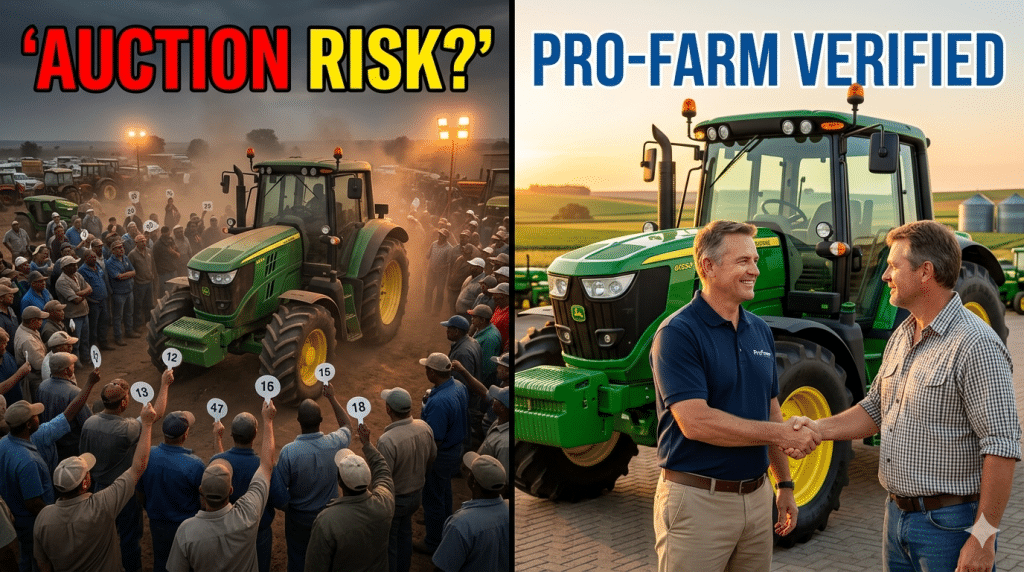
Johan Strydom thought he had found the deal of the season. A 2018 John Deere 6130R with 3,400 engine hours, hammer price R980,000 at an online auction, well below the R1,250,000 he had been quoted by two dealers. He paid the buyer’s premium, arranged a transporter from Kroonstad to his farm outside Lichtenburg, and waited. When the tractor arrived three days later, the hydraulic remote valves were sluggish on two circuits, the front axle had a shimmy above 15 kilometres per hour that suggested worn kingpins, and the precision ag display unit had a cracked internal connector that would require a John Deere dealership visit to diagnose properly. None of this was visible in the eight listing photographs. There was no recourse. The auction house had sold the machine voetstoots, as stated clearly in the terms and conditions he had accepted before placing his bid.
Johan’s experience is not unusual. It is the experience that the auction industry’s marketing does not put in its brochures.
This article is not an argument against auctions as a concept. Auctions serve a legitimate function in the South African agricultural equipment market, and for the right buyer in the right situation, they can deliver genuine value. What this article is, is a true-cost analysis. Because the hammer price is never the full price, and the gap between what a buyer pays at auction and what that machine actually costs them is frequently wide enough to erase the perceived saving entirely.
How Farm Equipment Auctions Work in South Africa
The South African agricultural auction market operates through a combination of physical on-site sales and online platforms, with several auctioneers running timed online auctions that have grown significantly in reach and volume over the past five years. The model is straightforward. Equipment is consigned by sellers, catalogued with photographs and basic hour meter readings, and sold to the highest bidder within a set timeframe. The auctioneer earns a commission from the seller and a buyer’s premium from the purchaser, typically ranging between five and ten percent of the hammer price, with VAT added on top of that premium.
The competitive dynamic of an auction is its primary appeal and its primary risk. The time pressure compresses the decision-making process. On a physical auction day, a buyer may have thirty minutes to walk around a machine before bidding opens. On an online auction, they are relying entirely on photographs, a brief description, and whatever they can establish from a phone call to the consigning seller, if that contact is even facilitated. The voetstoots principle, which means the buyer accepts the asset in whatever condition it exists at the time of sale, governs almost every agricultural auction in South Africa. The seller makes no warranties. The auctioneer makes no warranties. The buyer assumes all risk from the moment the hammer falls.
For high-value, mechanically complex assets like modern tractors, combine harvesters, and precision planting equipment, that risk is not trivial.
The Hidden Costs That the Hammer Price Does Not Reflect
Start with the buyer’s premium. On a R1,200,000 tractor, a ten percent buyer’s premium adds R120,000 before VAT on the premium is calculated. That immediately moves the effective purchase price to at least R1,257,600 before the machine has moved a metre. This is widely understood but routinely underweighted in the heat of competitive bidding.
Transport is the next cost that buyers frequently miscalculate. Farm equipment does not move itself. A lowbed transporter from the Boland to the Northern Cape, or from KwaZulu-Natal to the North West, can cost between R8,000 and R25,000 depending on distance, machine size, and current fuel costs. That transport happens before the buyer has physically inspected the machine in a working environment. If something is wrong, the machine has already moved. Getting it back, or getting it repaired before it can work, is now the buyer’s problem and the buyer’s cost.
Then there is the contingency for undisclosed faults, which is the cost that most buyers do not budget for at all because they do not expect it until it arrives. Modern tractors are sophisticated machines. A 2018 or 2019 model with GPS autosteer, ISOBUS compatibility, and electronic remote management has hundreds of diagnostic fault codes that will never appear in an auction photograph. Hydraulic wear, transmission slippage, differential lock engagement problems, air conditioning compressor condition, and the state of wear items like clutch plates and brake discs are all invisible to a camera. A gearbox rebuild on a mid-range tractor can cost R80,000 to R180,000. A hydraulic pump replacement on a large row-crop tractor starts at R45,000. An autosteer receiver and display unit replacement on a John Deere or Case IH precision ag package can exceed R60,000 for parts alone.
The cost of downtime is harder to quantify but arguably the most damaging of all. South African planting windows are unforgiving. In the Free State summer grain belt, the optimal planting window for maize can be as short as three to four weeks. A tractor that arrives with a fault that requires a dealership diagnosis, parts ordering, and a technician visit can sit idle for two to three weeks in a country where spare parts supply chains are not always reliable and dealership workshop capacity is frequently stretched. The cost of that lost planting opportunity, in yield foregone or contract penalties, can dwarf the cost of the mechanical fault itself.
Load-shedding has introduced a new layer of hidden risk that barely existed five years ago. Precision agriculture electronics, including GPS units, telematics modules, and ISOBUS controllers, are sensitive to voltage irregularities. Equipment that has been operated on farms without adequate generator protection, or stored in conditions without proper battery management, can carry electrical damage that shows no external symptoms but will surface quickly under working load. This is the kind of fault that only a proper inspection, with the machine running under load and all electronic systems active, can reliably detect.
What a Verified Agent Actually Does
The ProFarm agent model is built on a straightforward premise. Before any machine is listed, a verified agent conducts a physical inspection that covers the mechanical condition of the drivetrain, hydraulic system, electrical and electronic systems, structural integrity, and service history documentation. Hour meters are verified against service records where available. Known faults are disclosed in the listing, not buried in voetstoots small print.
This matters because the agent has no incentive to misrepresent the condition of the machine. The agent’s role is not to sell a specific piece of equipment at any price. It is to provide an independent assessment that allows a buyer to make a properly informed decision. The buyer is not relying on a seller’s optimistic description or an auctioneer’s catalogue photograph. They are relying on a professional assessment conducted by someone whose reputation depends on accuracy.
The practical result is that a buyer purchasing through the ProFarm platform is, in effect, outsourcing their pre-purchase due diligence to someone with the expertise and the physical access to do it properly. For buyers who are not themselves mechanical engineers, or who are purchasing equipment from a province they cannot easily travel to for an inspection, this is not a convenience. It is a genuine risk reduction.
A Cost Scenario Comparison
Consider a hypothetical purchase of a pre-owned tractor with a realistic market value in the current South African market of approximately R1,200,000. The comparison below uses conservative estimates for the auction cost variables.
| Cost Element | Auction Path | ProFarm Agent Path |
|---|---|---|
| Purchase price / hammer price | R1,200,000 | R1,260,000 |
| Buyer’s premium (8% + VAT) | R109,824 | — |
| Transport to farm | R15,000 | R15,000 |
| Pre-purchase inspection | — | Included |
| Fault contingency budget (conservative) | R60,000 | R10,000 |
| Effective total cost | R1,384,824 | R1,285,000 |
The auction machine carries a listed price R60,000 lower. The effective cost is R99,824 higher. And the fault contingency in the auction column is conservative. On a machine with undisclosed hydraulic or transmission wear, that number could double or triple.
This is not a calculation designed to make auctions look bad. It is a calculation designed to make the full cost visible, because the full cost is what a farming business actually pays.
When Auctions Do Make Sense
Honesty requires acknowledging that auctions are not the wrong choice for every buyer. A buyer who has the mechanical expertise to conduct a thorough physical inspection on the auction day, who has reliable transport arranged, who understands and accepts the voetstoots risk, and who has the financial buffer to absorb an unexpected repair, can acquire quality equipment at genuine value through an auction. Experienced equipment dealers do exactly this, regularly and profitably.
The problem is that the typical commercial farmer making a once-every-five-or-seven-years tractor or harvester purchase is not in that position. They are not equipment dealers. They are farmers, and their expertise is in farming. Expecting them to diagnose a potential gearbox issue on a running tractor in thirty minutes, under the social pressure of an active auction, is unrealistic. The auction model is built for sophisticated repeat buyers. It routinely catches everyone else.
The Decision That Matters Before You Bid
The South African pre-owned agricultural equipment market in 2026 is active, competitive, and well-supplied. There are good machines available through multiple channels, and a buyer who does their homework thoroughly can find value in all of them. The question is not where the cheapest listing price is. The question is what that machine will actually cost you, in rand, in time, and in operational disruption, from the moment it arrives on your farm.
A verified agent inspection does not eliminate all risk. No inspection does. What it does is convert unknown risk into disclosed risk, which is a fundamentally different thing when you are making a R1,000,000-plus capital decision on an asset that your livelihood depends on working correctly during a three-week planting window.
Browse ProFarm’s verified agent listings at profarm.co.za/equipment or contact the ProFarm team directly to discuss what is currently available in your equipment category and region.
ProFarm Agri is a South African verified-agent platform for pre-owned agricultural equipment, connecting commercial farmers with inspected, honestly represented machinery across all major categories.