Pieter Hanekom farms 1,800 hectares of dryland maize and sunflower in the Schweizer-Reneke district. In the winter of 2024 he bought a 2016 John Deere S660 combine with 2,100 engine hours from a private seller in the Eastern Free State. The price was fair, the machine looked clean in the photographs, and the seller assured him the combine had been serviced regularly. What Pieter discovered during his first harvest was that the concave clearance was uneven across the width of the threshing cylinder, the grain loss monitor sensors on two sections had been disconnected rather than repaired, and the feeder house chain had been replaced recently but with a non-OEM chain that stretched under load within forty hours of use. His 2024 harvest yield was measurably lower than his agronomist’s projections, and he could not be certain how much of that loss was weather-related and how much was walking out the back of a combine that was not threshing cleanly.
That is the combine harvester problem in concentrated form. It is not a machine you can evaluate by walking around it. It is a machine you can only truly evaluate by running it through crop at full capacity, which is precisely the condition under which you cannot inspect it before you buy it.
This guide exists to narrow that gap. It will not make a combine purchase risk-free. Nothing will. What it will do is give you a structured framework for evaluating a used combine in the South African market, with specific focus on the mechanical and electronic signals that separate a well-maintained machine from one that has been managed for presentation rather than performance.
Why Combine Hours Are Not What You Think They Are
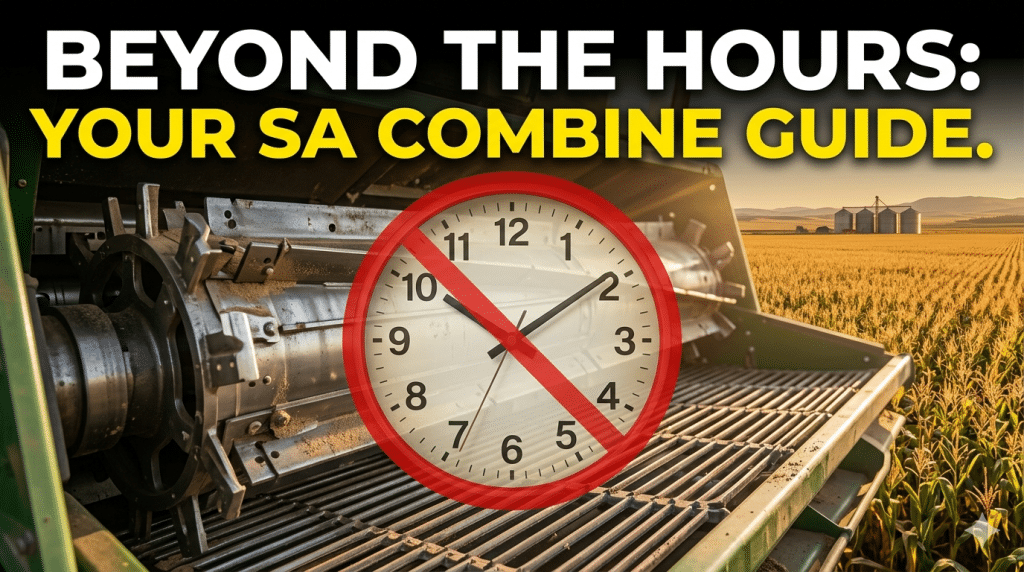
The hour meter on a combine harvester is the first number every buyer looks at and the number that deserves the most scepticism. Engine hours record total running time, including road travel, field positioning, and unloading time when the threshing mechanism is not engaged. A combine with 2,500 engine hours that spent significant time in transport or on large farms with long field runs may have substantially fewer separator hours than those engine hours suggest. Conversely, a machine with 1,800 engine hours that spent its entire working life on small, irregular fields with frequent stopping and starting may have worked its threshing and separating systems harder than the dashboard figure implies.
The number that matters far more than engine hours is rotor or cylinder hours, sometimes called separator hours or threshing hours depending on the manufacturer’s terminology. This is the count of hours the threshing mechanism has actually been running under load, processing crop. On a John Deere S-series or a Case IH Axial-Flow, this figure is stored in the machine’s diagnostic system and can be retrieved with the correct service tool. Any seller who cannot or will not provide this figure is selling you a machine whose most critical wear metric is unknown. That should immediately adjust your risk assessment and your offer price.
On older machines where separator hours are not electronically recorded, an experienced technician can estimate rotor wear through physical inspection of the rotor bars, concave grates, and cylinder housing. This is not an exact science, but it is far more informative than an engine hour figure alone.
The Threshing System: Where Value Is Lost and Found
The threshing and separation system is the heart of any combine, and it is the system most likely to carry wear that is invisible at a standstill. On conventional straw-walker combines, which remain common in the South African market particularly in the New Holland and older John Deere range, the cylinder and concave are the primary threshing components. On rotary machines including the John Deere S and T series and the Case IH Axial-Flow range, the rotor and concave perform the same function across a longer processing path.
Concave condition is the first thing to assess. The concave grates wear progressively, and uneven wear across the width of the concave creates uneven threshing performance that shows up as elevated grain loss at the back of the machine. This is exactly the fault Pieter Hanekom experienced, and it is one that sellers frequently do not disclose because it requires running the machine through crop to detect conclusively. A physical inspection of the concave when the machine is stationary can reveal obvious grate wear, cracks, or weld repairs, but marginal wear that still produces measurable grain loss requires a more detailed assessment.
Rotor bar condition on rotary machines tells a similar story. Worn or damaged rotor bars reduce the aggressiveness of threshing, which on maize can mean incomplete cob processing and elevated whole grain loss. Replacement rotor bars are available and the repair is not catastrophic, but the cost needs to be factored into any purchase price negotiation.
The straw walkers on conventional machines are worth examining closely for cracks, particularly at the finger attachment points. Cracked straw walkers are a known wear point and a moderately expensive repair. Look for weld repairs along the walker length, which indicate prior cracking that has been addressed but which may recur under continued stress.
Feeder House and Crop Intake Condition
The feeder house is the first point of contact between the combine and the crop, and it takes significant abuse across a harvest season. The feeder house chain, which drives crop up from the header into the threshing system, is a wear item that experienced sellers will replace before a sale specifically because it is visually obvious when worn. This is worth noting: a recently replaced feeder house chain is not necessarily a positive signal. It may indicate that the previous chain was worn to the point of requiring urgent replacement, which raises questions about the broader maintenance culture on that machine.
Check whether the replacement chain is OEM specification. Non-OEM feeder house chains are cheaper to purchase but frequently stretch more rapidly under load, which creates feeding irregularities and accelerated wear on the sprockets. Ask for the purchase invoice for the replacement chain if it was recently fitted.
The feeder house reverser, which allows the operator to clear blockages without manual intervention, should engage and disengage cleanly. Sluggish or inconsistent reverser operation suggests wear in the clutch mechanism that will worsen with use.
Inspect the feeder house floor for impact wear and cracks. On maize operations in particular, where stalks and cobs generate significant impact loads, the feeder house floor takes punishment that accumulates over seasons. Cracks that have been welded indicate prior stress failure, and the area around the weld should be examined for secondary cracking.
Grain Handling and Loss Monitor Systems
The grain elevator, clean grain auger, and tailings return system are moderately straightforward to assess but frequently overlooked by buyers focused on the threshing system. Run the grain handling system without crop and listen for bearing noise in the elevator, particularly at the top of the clean grain elevator where grain impact and bearing load combine. Worn elevator paddles reduce throughput capacity and, on high-output modern combines, can become a bottleneck that limits effective field capacity below the machine’s rated performance.
The grain loss monitors deserve specific attention. These sensor arrays, positioned at the straw walkers or rotor discharge area and at the shoe and chaffer, measure grain loss by detecting grain impacts on sensing plates. They are the operator’s primary feedback tool for optimising machine settings during harvest. On older machines, these sensors are frequently damaged by impact or simply disconnected after failure because repair was inconvenient. A combine with non-functional grain loss monitors is a machine that has been operated without the primary performance feedback tool for an unknown number of seasons. The grain loss during that period is unknown. The calibration of the machine’s settings relative to actual crop conditions is unknown.
Ask the seller to demonstrate the grain loss monitor system operating and displaying live readings with the machine running. If the sensors have been disconnected or the display shows persistent fault codes, factor the full cost of sensor replacement and recalibration into your assessment.
Precision Agriculture Electronics and Telematics
The South African combine market contains a wide range of model years, and the precision agriculture capability of machines varies significantly across that range. A 2015 or newer John Deere S-series with JDLink telematics offers remote diagnostic access that allows a buyer, with the seller’s cooperation, to retrieve the machine’s historical fault code log, engine load data, and operating parameter history. This data is extraordinarily useful for a pre-purchase assessment and costs nothing to access if the machine is still connected to the JDLink system. Ask for it.
Case IH AFS Connect-equipped machines offer equivalent remote diagnostic capability. New Holland’s PLM Connect system provides similar access on compatible models. If a machine is equipped with any of these telematics systems and the seller cannot or will not provide access to the historical data, the question worth asking is why.
Load-shedding has created a specific electronics risk in the South African fleet that buyers need to account for. Combines equipped with sophisticated electronic management systems, including variable rate header control, automated concave adjustment, and active yield mapping, are sensitive to voltage irregularities during startup and shutdown. Machines that have been operated through years of load-shedding without adequate generator or UPS protection for their electrical systems may carry latent electronic damage that manifests under field operating conditions. This is not visible during a static inspection. It requires the machine to be operated under load with all electronic systems active and monitored.
The Regional Service Network Factor
A combine harvester without accessible dealership support is a liability during harvest. This sounds obvious but is routinely underweighted in purchase decisions driven primarily by price and hour meter.
In South Africa, John Deere and Case IH have the strongest dealer network coverage across the primary grain producing regions of the Free State, North West, Mpumalanga, and Gauteng surrounds. New Holland’s network is adequate in certain regions but thinner in others. Claas has a presence in specific areas with strong roots in certain farming communities. The practical question is not which brand is theoretically superior but which brand has a dealership with workshop capacity and parts stock within a reasonable distance of your farm.
A two-hour drive to the nearest dealership is manageable for a scheduled service. It is a serious operational problem during harvest when a machine goes down on a Wednesday afternoon with standing crop and a weather window closing. Parts availability matters as much as dealership proximity. For older machines, particularly those outside the current model range, the availability of wear parts, electronic components, and specialist technicians needs to be verified before purchase, not discovered after breakdown.
What to Ask the Seller Before You Inspect
The questions you ask a seller before you travel to inspect a machine reveal as much about the machine as the inspection itself. A seller who answers mechanical questions confidently and specifically, who can produce service records without hesitation, and who volunteers information about known faults or recent repairs is telling you something important about how that machine was managed. A seller who deflects technical questions, cannot produce service documentation, or responds to specific inquiries with generalities is also telling you something important.
Ask specifically: What is the rotor or separator hour count? Is the telematics system active and can you provide access to the fault code history? What wear items have been replaced in the last two seasons and by which workshop? Are there any known faults or recurring issues with the machine? What is the reason for selling?
The answer to the last question is particularly instructive. Legitimate reasons for selling a combine are common and unsuspicious: farm consolidation, brand change, capacity upgrade, retirement, or financial restructuring. A seller who cannot articulate a clear reason for selling a machine that, on paper, appears to be in good working order is worth approaching with additional caution.
The ProFarm Inspection Advantage on High-Value Harvesting Equipment
A combine harvester is among the highest-value, highest-risk single asset purchases in South African commercial farming. The mechanical complexity is significant, the seasonal dependence is absolute, and the consequences of a poor purchasing decision play out over multiple harvest seasons in ways that are difficult to quantify but easy to feel.
ProFarm’s verified agent model addresses this risk directly. Before any combine or harvesting equipment is listed on the platform, a verified agent conducts a structured physical inspection covering the threshing and separation system, feeder house, grain handling system, electronic and precision ag components, and structural condition. Known faults are disclosed. Hour meter data is verified against service records where available. The buyer receives an honest condition assessment rather than a marketing description.
For South African grain farmers making a capital decision of this magnitude, the difference between an inspected asset and an uninspected one is not a matter of convenience. It is a matter of whether the machine that arrives on your farm is the machine you thought you were buying.
Browse ProFarm’s current combine harvester and harvesting equipment listings at profarm.co.za/combines-headers or contact the ProFarm team to discuss available stock in your region and price range.
ProFarm Agri is a South African verified-agent platform for pre-owned agricultural equipment, connecting commercial farmers with inspected, honestly represented machinery across all major equipment categories.