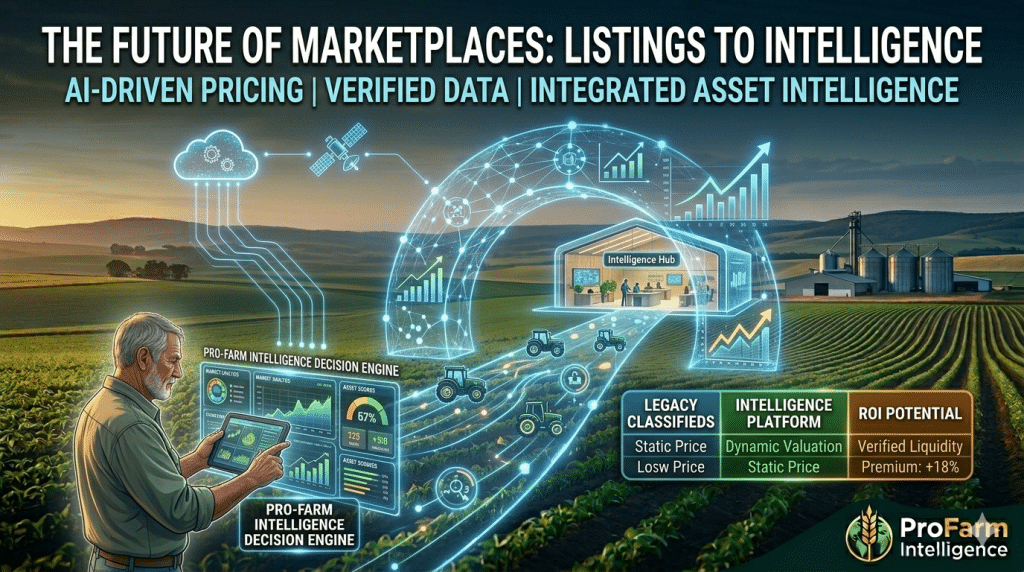
Agricultural equipment marketplaces are undergoing a structural shift that most participants still underestimate. What began as simple classified listings has evolved into something far more consequential: data-driven intelligence systems that influence how farmers buy, sell, and value machinery.
In South Africa, where agricultural margins are tightly linked to timing, input costs, and equipment efficiency, this transition is not theoretical—it is already reshaping decision-making behaviour across the sector.
The question is no longer “Where can I list my equipment?”
It is becoming “What does the data say my equipment is worth, and when should I act?”
The Traditional Marketplace Model (Listings Era)
For decades, the agricultural equipment marketplace operated on a simple model:
- Classified listings
- Dealer advertisements
- Auction catalogues
- Word-of-mouth sales networks
This structure was fundamentally static and transactional. It provided visibility but not intelligence.
Core characteristics of the listings model:
- No structured pricing intelligence
- Limited transparency on transaction history
- Heavy reliance on negotiation
- Information asymmetry between buyer and seller
- Pricing based on perception rather than data
In this environment, value was often subjective. Two identical tractors could sell for significantly different prices depending on negotiation strength, timing, and local demand visibility.
The system functioned—but it was inefficient.
Why the Old Model Is Breaking Down
The breakdown of the listings-era marketplace is driven by structural economic and technological pressures.
1. Rising Equipment Costs
Agricultural machinery prices have increased significantly due to:
- Global supply chain constraints
- Currency volatility
- Increased technology integration in equipment
- Higher input manufacturing costs
This makes valuation accuracy more important than ever.
2. Agricultural Input Volatility
Farmers operate in an environment where:
- Fuel prices fluctuate
- Fertiliser costs spike unpredictably
- Climate variability affects yield planning
These pressures increase the need for better capital allocation decisions, including equipment timing.
3. Demand for Faster Decision Cycles
Modern farming operations cannot wait weeks or months for inefficient market discovery.
Decisions increasingly require:
- Rapid valuation insights
- Market timing intelligence
- Comparable asset benchmarking
4. Digital Transformation of Farming Operations
Farms are becoming data environments:
- Precision agriculture systems
- Telemetry-enabled machinery
- GPS and yield mapping tools
As farm operations digitise, equipment markets are being pulled in the same direction.
The Rise of Agricultural Intelligence Platforms
A new category is emerging: agricultural intelligence platforms.
These systems do not simply list equipment—they interpret market behaviour.
Instead of static advertisements, they provide:
- Pricing signals
- Demand trends
- Asset lifecycle modelling
- Regional supply and demand mapping
This is a shift from market visibility to market understanding.
Key capabilities emerging in this category:
- Predictive pricing models based on historical sales data
- Equipment depreciation forecasting
- Buyer demand heatmaps
- Usage-based valuation systems (hours, condition, workload)
- Automated matching between buyers and sellers
Globally, similar transitions have already occurred in:
- Financial markets (trading platforms → analytics systems)
- Logistics (load boards → optimisation engines)
- Real estate (listings → valuation ecosystems)
Agricultural equipment is now following the same trajectory.
From Listings to Decision Systems
The most important transformation is conceptual.
Old paradigm:
- “What is available?”
New paradigm:
- “What is the correct decision?”
This changes the role of the marketplace entirely.
Instead of being a directory, it becomes a decision support system.
This shift introduces three major changes:
1. From Listings → Valuation Intelligence
Equipment is no longer just posted; it is:
- Benchmarked
- Modelled
- Compared across datasets
2. From Discovery → Timing Optimisation
The key question becomes:
- Should I sell now, or wait for a stronger liquidity window?
3. From Static Ads → Dynamic Market Signals
Pricing is no longer fixed by the seller alone:
- It is influenced by demand trends
- Seasonal cycles
- Regional inventory levels
Core Components of a Modern Agri Intelligence Platform
To understand where the industry is heading, it helps to break down the building blocks of intelligence-driven marketplaces.
1. Real-Time Pricing Intelligence
Aggregates:
- Listing data
- Historical sales
- Dealer pricing patterns
Outputs:
- Estimated fair market value ranges
2. Equipment Depreciation Modelling
Tracks:
- Hours of use
- Age
- Maintenance history
Produces:
- Expected value decay curves per category
3. Regional Demand Mapping
Identifies:
- High-demand agricultural zones
- Seasonal demand shifts
- Equipment shortages or surpluses
4. Buyer–Seller Matching Systems
Instead of passive browsing:
- Buyers are matched to relevant listings
- Sellers reach targeted demand pools
5. Historical Transaction Intelligence
Moves beyond asking prices:
- Actual sale outcomes
- Time-to-sell metrics
- Price vs condition correlations
Impact on Farmers and Equipment Buyers
For end users, the shift to intelligence platforms has direct operational benefits.
1. Better Pricing Decisions
Farmers can avoid:
- Overpaying for underperforming equipment
- Undervaluing assets during resale
2. Reduced Purchase Risk
Data-backed insights reduce:
- Mechanical uncertainty
- Overestimated asset condition assumptions
3. Improved Timing Strategy
Users can identify:
- Optimal selling windows
- High-liquidity market periods
4. Lower Total Cost of Ownership
Decisions become lifecycle-based:
- Purchase price
- Maintenance expectations
- Resale value optimisation
Impact on Dealers and Marketplaces
The shift is even more significant for intermediaries.
1. From Inventory Control to Data Control
Competitive advantage moves from:
- Stock availability
to - Market intelligence depth
2. Monetisation of Insights
New revenue streams emerge:
- Pricing analytics subscriptions
- Market forecasting tools
- Data-driven advisory services
3. Increased Platform Differentiation
Marketplaces can no longer compete on listings alone.
They must compete on:
- Intelligence quality
- Prediction accuracy
- Decision support tools
Where ProFarm Intelligence Fits In
Within this evolving landscape, ProFarm Intelligence represents a transitional model between:
- Traditional agricultural marketplaces
- Next-generation intelligence platforms
Its positioning reflects a broader industry movement toward:
- Transparent pricing ecosystems
- Structured equipment valuation
- Data-informed buying and selling decisions
In the South African agricultural context, this evolution is particularly important due to:
- Regional price variability
- Diverse farming systems
- Uneven access to reliable market data
Platforms that integrate intelligence layers reduce fragmentation and improve market efficiency.
The Next 5–10 Years of Agricultural Marketplaces
Looking forward, several structural trends are likely to define the industry:
1. AI-Driven Equipment Valuation
Automated systems will:
- Estimate real-time asset values
- Adjust for condition, usage, and demand
2. Predictive Resale Timing Tools
Farmers will receive guidance such as:
- “Optimal sell window approaching in 3 months”
- “Market liquidity peak expected pre-harvest”
3. Integrated Agricultural Data Ecosystems
Equipment marketplaces will connect with:
- Farm management systems
- Yield data platforms
- Financial institutions
4. Cross-Platform Agri-Finance Integration
Lenders will increasingly rely on:
- Equipment valuation models
- Market demand forecasts
- Asset liquidity scoring
This will directly influence:
- Loan approvals
- Interest rates
- Asset-based financing structures
FAQ
What is an agricultural intelligence platform?
It is a system that goes beyond listings by providing pricing insights, demand analysis, and data-driven decision support for agricultural equipment transactions.
How is a farm equipment marketplace changing?
It is shifting from static classifieds to dynamic systems that integrate valuation models, market trends, and predictive analytics.
Will classifieds still exist in agriculture?
Yes, but they will increasingly be embedded within intelligence systems rather than functioning as standalone discovery tools.
How does data improve equipment pricing accuracy?
By aggregating historical sales, usage data, and demand trends, platforms can estimate fair market value ranges more precisely than manual estimation.
Final Insight
The agricultural equipment marketplace is moving from visibility to intelligence.
In the past, success depended on finding buyers or sellers. In the future, success will depend on understanding:
- What something is worth
- When to act
- How the market is shifting
This transformation is not gradual—it is structural.
And in that shift, platforms that evolve from listings into intelligence systems will define the next era of agricultural commerce in South Africa.