Selling agricultural equipment is often treated as a reactive decision—something done when cashflow tightens or when a replacement becomes unavoidable. That approach almost always results in value leakage.
In South Africa’s agricultural machinery market, timing is not a secondary factor; it is a pricing multiplier. The same tractor can vary significantly in resale value depending on when it is listed, how inventory levels look in the market, and where the agricultural production cycle sits.
This guide breaks down the seasonal dynamics behind the best time to sell farm equipment in South Africa, and how to structure your sale for maximum return.
Why Timing Matters in Equipment Sales
Agricultural equipment pricing is driven by a simple but often ignored principle: liquidity follows agricultural cycles.
Unlike passenger vehicles, farm machinery demand is tightly coupled to:
- Planting and harvesting schedules
- Cashflow cycles in farming operations
- Seasonal rainfall and production planning
- Input cost pressure (fuel, fertiliser, feed)
When farmers are preparing for planting or harvesting, liquidity increases and demand rises. When those cycles pass, the market shifts into surplus—more sellers, fewer buyers.
This creates what can be described as “liquidity windows”—short periods where sellers can extract maximum value.
Missing these windows often results in:
- Longer time-to-sell
- Higher negotiation pressure
- Lower final sale price
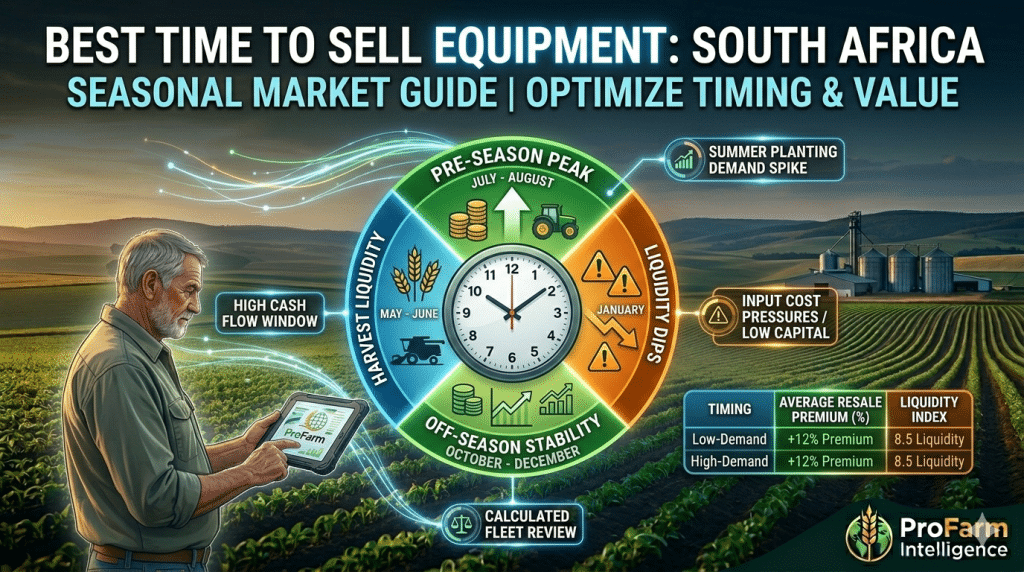
South African Agricultural Equipment Market Cycles
South Africa’s agricultural calendar varies slightly by region and crop type, but broad patterns remain consistent across most commercial farming sectors.
1. Pre-Harvest Demand Phase
This is one of the strongest selling periods.
Farmers are:
- Preparing to scale operations
- Replacing underperforming equipment
- Securing additional capacity before peak workload
During this phase:
- Demand for tractors and harvest-related machinery increases
- Buyers are more willing to pay premium prices
- Financing approvals are more active
This is typically one of the best liquidity windows for sellers.
2. Harvest Season Pressure Phase
During harvest, market behaviour shifts.
Farmers are:
- Focused on operations, not procurement
- Experiencing cashflow strain due to input recovery cycles
- Less willing to commit to large capital purchases
Result:
- Demand stabilises or weakens
- Buyers become more selective
- Negotiation pressure increases
This is generally not an optimal selling period unless urgency exists.
3. Post-Harvest Surplus Phase
This is the most challenging period for sellers.
Market conditions:
- Many farmers are offloading surplus or underutilised equipment
- Inventory in the market increases sharply
- Buyer demand slows due to recent capital expenditure
Outcome:
- Increased competition among sellers
- Lower average resale values
- Longer listing cycles
This is typically the lowest pricing environment of the year.
4. Off-Season Stabilisation Phase
In this phase:
- Market activity slows but stabilises
- Serious buyers re-enter the market to prepare for the next cycle
- Inventory pressure decreases
This period can present selective opportunities, especially for well-maintained or niche equipment.
Best Months to Sell Agricultural Equipment in South Africa
While exact timing depends on crop type and region, general market intelligence points to the following patterns:
High-Demand Selling Windows
- Late winter to early spring (pre-planting preparation phase)
- Early summer (equipment scaling for harvest readiness)
During these periods:
- Buyer urgency increases
- Financing activity improves
- Competition among buyers increases
This is typically where sellers achieve strongest negotiation positions.
Low-Demand Risk Periods
- Immediately post-harvest
- Mid-winter slowdowns in certain regions
- Periods following major equipment auction saturation
During these windows:
- Buyer pool shrinks
- Inventory is high
- Price pressure intensifies
Equipment Type vs Selling Timing
Not all machinery follows the same demand curve.
Tractors
- Most stable demand category
- Strongest during pre-planting cycles
- Value holds better year-round but still season-sensitive
Harvesters
- Highly seasonal demand
- Strong pre-harvest spikes
- Weak post-harvest liquidity
Implements (ploughs, planters, sprayers)
- Linked closely to planting cycles
- Demand peaks immediately before seasonal field preparation
Irrigation Equipment
- Less seasonal, more climate-driven
- Demand influenced by drought cycles and water availability
Understanding category behaviour is essential to timing decisions correctly.
Factors That Influence Resale Value Beyond Timing
Timing is powerful, but it does not operate in isolation.
1. Machine Condition
Well-maintained equipment can partially offset poor timing decisions.
Key indicators:
- Service history consistency
- Engine and hydraulic condition
- Structural integrity
2. Engine Hours and Usage Intensity
Lower hours generally improve value, but only when consistent with physical condition.
3. Brand Strength
Certain brands consistently retain value better due to:
- Parts availability
- Dealer networks
- Perceived reliability
4. Market Inventory Levels
High supply reduces pricing power regardless of season.
5. Input Cost Environment
Fuel and fertiliser prices indirectly affect equipment purchasing behaviour.
Strategic Selling Framework (ProFarm Intelligence Model)
A structured approach improves decision accuracy significantly.
1. Condition Score
Evaluate:
- Mechanical integrity
- Cosmetic condition
- Service history completeness
2. Market Demand Score
Assess:
- Current buyer activity
- Comparable listings
- Regional demand intensity
3. Seasonality Score
Determine:
- Position in agricultural cycle
- Proximity to planting/harvest phases
4. Urgency Score
Factor in:
- Cashflow requirements
- Storage costs
- Replacement needs
By combining these four variables, sellers can move from reactive selling to strategic asset timing.
Common Mistakes Farmers Make When Selling Equipment
1. Selling Under Financial Pressure
Urgency often overrides timing logic, leading to undervalued sales.
2. Treating Equipment Value as Static
Asset value is dynamic and heavily influenced by market cycles.
3. Ignoring Seasonal Demand Windows
Many sellers list equipment during low-liquidity periods unintentionally.
4. Waiting Too Long
Delaying a sale can result in:
- Higher maintenance costs
- Depreciation acceleration
- Reduced buyer interest
How to Maximise Selling Price
1. Time the Market
Align listings with pre-planting or pre-harvest demand phases.
2. Improve Presentation
- Clean and service equipment before listing
- Address minor repairs that reduce perceived value
3. Prepare Documentation
Complete service records and ownership documents increase buyer confidence.
4. Choose the Right Sales Channel
- Private sale: higher control, slower process
- Auction: faster liquidity, variable pricing
- Marketplace listing: balanced exposure
FAQ
What is the best month to sell a tractor in South Africa?
Generally, pre-planting periods in spring offer the strongest pricing and buyer demand conditions.
Do tractors sell better before or after harvest?
Tractors typically sell better before harvest due to increased operational demand and buyer urgency.
How much value does farm equipment lose per year?
Depreciation varies, but usage intensity and maintenance quality often matter more than time alone.
Should I sell at auction or privately?
Auctions offer speed and liquidity, while private sales typically yield higher final prices if timing is optimal.
Final Insight
The resale value of agricultural equipment is not fixed—it is a function of timing, demand cycles, and market liquidity.
Farmers who treat selling as a strategic decision rather than a reactive one consistently outperform the market. Understanding seasonal cycles in South Africa’s agricultural economy is the difference between selling at market value and selling below it.
In practical terms, the best time to sell farm equipment in South Africa is not a single date—it is a window. Recognising that window is where value is protected.