By ProFarm Intelligence | June 2026
The 2026 Economic Lens: A Strategic Pivot
In the South African agricultural landscape of 2026, the traditional reflex to purchase equipment outright is facing a rigorous reality check. With sustained interest rate pressures and volatile input costs, the “buy-to-own” model is no longer the default path to prosperity.
For commercial farmers, the challenge has shifted from simple asset acquisition to liquidity preservation. As machinery technology rapidly evolves—moving toward higher precision and data-backed performance—the risk of asset obsolescence has increased. Today, capital allocation must be driven by operational efficiency rather than traditional ownership pride.
The Comparative Framework: Ownership vs. Flexibility
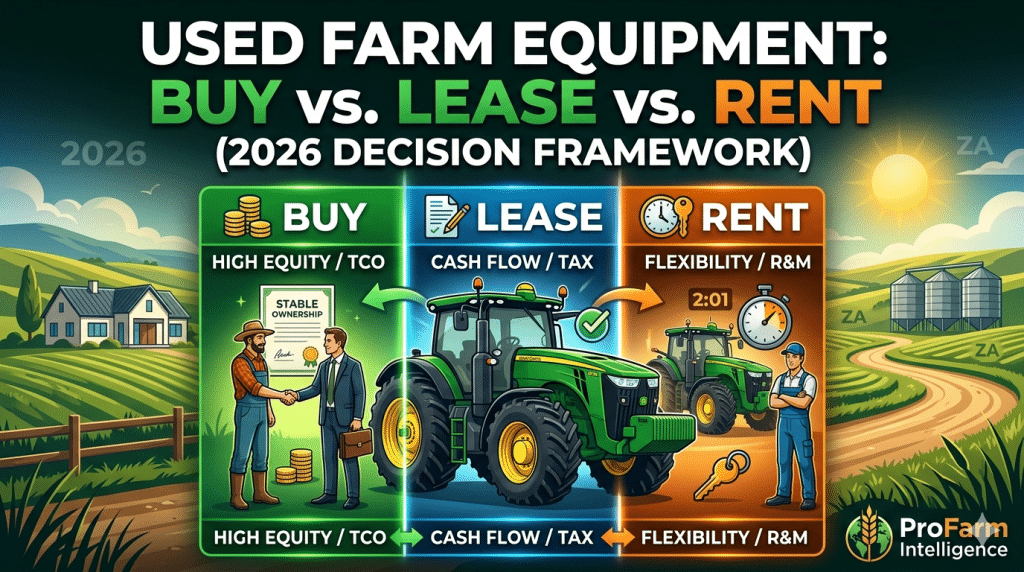
Choosing the right machinery strategy requires a clear understanding of the three pillars of equipment deployment:
1. Buying (Asset Ownership)
- The Model: Direct purchase using cash reserves or long-term asset finance.
- Best For: Core equipment that runs high annual hours, where the machine is a permanent fixture of your long-term operational workflow.
- Strategic Advantage: Provides absolute control over the machine’s maintenance and customization, building long-term equity in the balance sheet.
2. Leasing (Operating or Finance Lease)
- The Model: A mid-term contract (typically 3–5 years) that bridges the gap between renting and buying.
- Best For: Upgrading to modern, high-precision technology without the immediate “out-of-pocket” capital drain.
- Strategic Advantage: Allows for superior cash flow management and often provides tax advantages depending on whether it is structured as an operating or finance lease.
3. Renting (Short-term/Seasonal)
- The Model: Flexible, pay-per-use agreements for specific seasonal demands.
- Best For: Specialized equipment needed only for short windows (e.g., specific harvesting or planting tools) or when testing new technology before committing to a purchase.
- Strategic Advantage: Transfers the burden of major maintenance and depreciation risk entirely to the lessor, keeping your operational liquidity high.
Decision Engine: Strategic Variables
| Feature | Buying | Leasing | Renting |
|---|---|---|---|
| Upfront Cost | High | Low | Minimal |
| Tax Implications | Depreciation/Interest | Deductible Expense | Fully Deductible |
| Maintenance | Owner Responsibility | Contract Dependent | Lessor Responsibility |
| Primary Use Case | Core Fleet Assets | Tech Upgrades | Seasonal/Specialized |
Key Decision Metrics: TCO vs. Cost of Operation
To make an informed decision, you must differentiate between Total Cost of Ownership (TCO) and Cost of Operation.
- Total Cost of Ownership (TCO): Includes the purchase price, interest, maintenance, insurance, and the projected residual value after 5 years. Use this for your core, long-term fleet.
- Cost of Operation: Includes fuel, labor, daily servicing, and short-term rental fees. Use this to determine if a machine is creating a profit bottleneck during peak season.
The ProFarm 2026 Rule: If the annual TCO of a new purchase exceeds 25% of the machine’s utility-generated revenue, you should pivot to a lease or rental strategy to preserve your farm’s liquidity.
Which Strategy Wins in 2026?
The “winning” strategy in 2026 is Hybrid Asset Management.
Successful commercial operations are increasingly buying their “workhorse” tractors (standardized, high-reliability units) while leasing or renting specialized, high-tech implements. This strategy minimizes the impact of rapid technological depreciation on the high-cost, tech-heavy assets, while ensuring that the core machinery remains a reliable, equity-building component of the farm.
Conclusion: Move from Instinct to Intelligence
Financial strategy in agriculture is no longer about gut feeling; it is about modeling variables to protect your margins.
Are you modeling your equipment acquisition correctly? Don’t rely on generic benchmarks. Use the ProFarm Intelligence Cash Flow Modeler to input your current farm data, interest rate assumptions, and operational hours to determine whether buying, leasing, or renting is the most efficient path for your 2026 crop cycle.
ProFarm Intelligence – Transforming data into agricultural confidence.