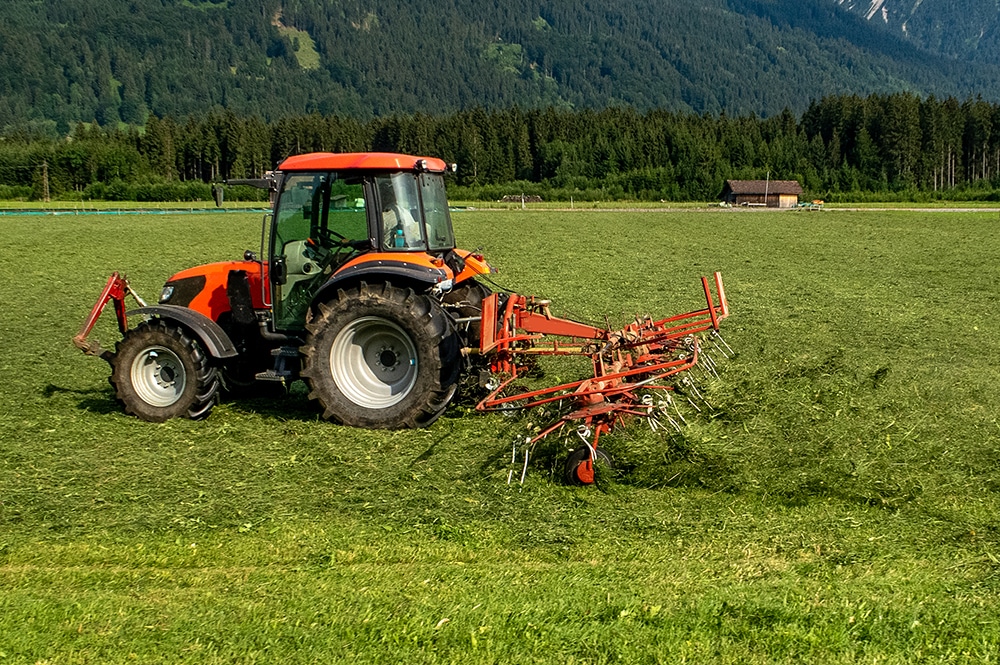
Evaluating a pre-owned tractor purely on total dashboard hours is a fundamentally flawed asset valuation strategy. The hour meter is a blunt instrument. It records time, but it completely fails to record mechanical intensity. A machine registering 4,000 hours could represent a pristine asset or a looming liability, depending entirely on how those hours were accumulated. Capital allocation requires understanding the exact mechanical history of the unit. Treating all hours as equal invites severe financial risk into a farming operation.
The Mechanical Reality of PTO Hours (High Torque Stress)
Power Take-Off (PTO) applications subject a tractor to extreme, sustained mechanical violence. Running heavy implements like large square balers, forage harvesters, or heavy-duty mowers forces the engine to operate continuously near its maximum torque curve. This transfers massive torsional stress directly through the drivetrain. The PTO clutch pack and planetary gear systems bear the brunt of this load. Sustained high-rpm stationary work also heavily taxes the cooling system, as there is zero ram-air effect to assist the radiator. A tractor with 2,000 hours of heavy PTO work has a vastly degraded internal wear profile compared to one performing light draft work.
Standard Engine Hours: Idling, Transport, and Misleading Wear
Conversely, a tractor displaying 5,000 hours primarily accumulated through road transport or prolonged idling presents a different set of hidden liabilities. High idling hours drop cylinder temperatures. This incomplete combustion leads to wet stacking, where unburned fuel washes lubricating oil off the cylinder walls, accelerating piston ring wear and pushing raw diesel into the exhaust system. Transport hours, while less taxing on the engine block, subject the front axle suspension, steering linkages, and transmission synchronizers to high-cycle repetitive stress. Assuming a tractor with high engine hours but low draft work is “clean” ignores the reality of localized mechanical fatigue.
Component Wear Comparison
| Component System | High PTO Hour Impact | High Idle/Transport Hour Impact | Forensic Inspection Check |
|---|---|---|---|
| Engine Internal | High thermal load; accelerated main bearing wear. | Wet stacking; cylinder glazing; DPF loading. | Oil analysis (metals); blow-by assessment. |
| Transmission / Drivetrain | Severe PTO clutch pack degradation; planetary gear fatigue. | Synchronizer wear (from roading); gear lash. | Shift pressure tests; transmission fluid particulate check. |
| Cooling System | Heat-soak degradation; viscous fan clutch failure. | Minimal impact. | Coolant pressure test; radiator fin flow check. |
| Front Axle & Steering | Minimal impact (if stationary). | Kingpin wear; tie-rod fatigue; suspension bush degradation. | Jack up front axle to check lateral play. |
Decoding the ECM: The Value of Agent-Verified Inspections
Relying on a private seller’s verbal history of a machine’s workload introduces unacceptable information asymmetry. Verbal assurances do not protect a balance sheet from a failed transmission. Mitigating this risk requires interrogating the Engine Control Module (ECM). Modern ECMs log exact load profiles, lifetime fuel burn rates, and total PTO engagement time. ProFarm Agri’s agent-led physical inspections utilize diagnostic tools to pull this exact data. By verifying the actual workload distribution against the dashboard hour meter, ProFarm removes the guesswork. This verified data signals true mechanical condition, guaranteeing buyers understand the exact liability and operational lifespan of the asset before capital changes hands.