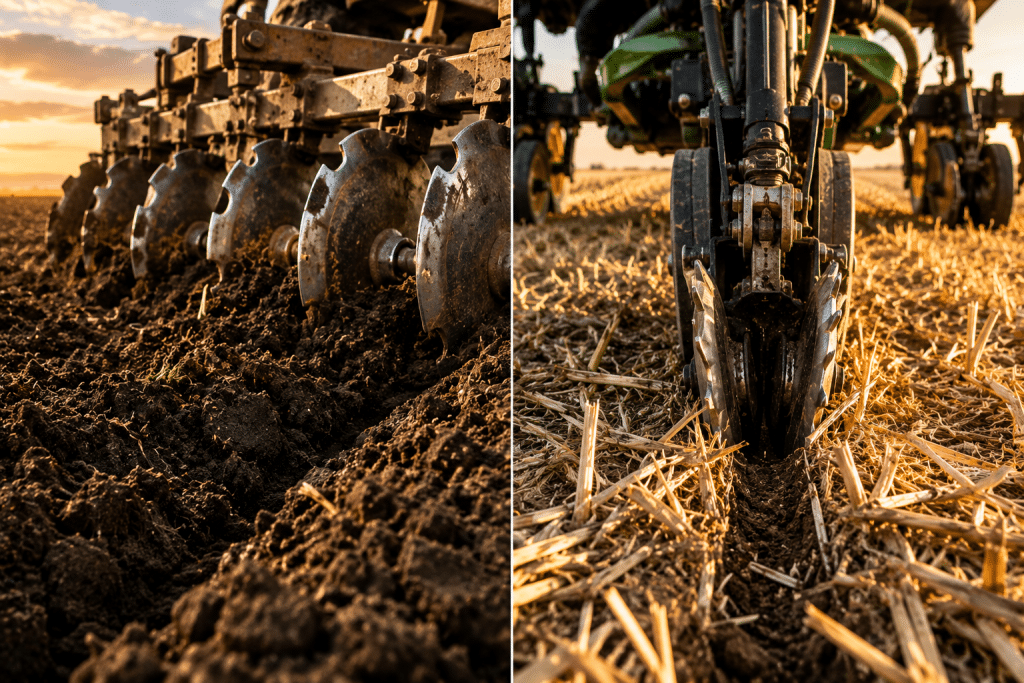
In South African agriculture, the debate over how to manage the soil has never been more critical. Between unpredictable rainfall, the lingering threats of drought, and the ever-climbing cost of diesel, farmers are constantly re-evaluating their ground preparation strategies.
There is no universal “right” answer. The choice between no-till (conservation agriculture) and conventional tillage depends heavily on your region’s climate, your soil type, and your capital budget. More importantly, the philosophy you adopt will completely dictate the machinery you need in your shed. Here is a breakdown of both strategies and how to match the right implements to your soil goals.
The Case for Conventional Tillage
Conventional tillage involves mechanically turning over the topsoil before planting. While it has fallen out of favor in some progressive circles due to fuel costs and carbon loss, it remains an essential and highly profitable practice in many South African regions—particularly in areas with heavy clay soils or severe weed resistance.
Why farmers use it:
- Breaking Soil Compaction: Heavy tractor traffic creates hardpans that restrict root growth. Deep ripping is often the only way to shatter these compacted layers.
- Managing Heavy Residue: In high-yielding irrigated maize operations, the sheer volume of leftover stover can choke a planter. Tillage chops and incorporates this organic matter into the soil profile.
- Pest and Weed Control: Turning the soil buries weed seeds and disrupts the lifecycle of soil-borne pests.
- Warming and Drying Soils: In cooler, wetter regions, tillage exposes dark soil to the sun, allowing lands to warm up and dry out faster for earlier planting.
Implements Required:
A conventional strategy requires a robust, high-horsepower fleet. Your shed will need heavy offset discs, moldboard plows, deep rippers, and power harrows. If you are building or maintaining a conventional fleet, sourcing durable, high-quality [Tillage Equipment] is the foundation of your success.
The Case for No-Till (Conservation Agriculture)
No-till farming aims to leave the soil completely undisturbed, planting the new crop directly into the stubble of the previous season. In moisture-scarce regions like the Swartland or the dryland western Free State, no-till is less of a trend and more of a survival strategy.
Why farmers use it:
- Maximum Moisture Retention: The undisturbed residue acts as a mulch, drastically reducing evaporation and keeping root zones cool during mid-summer heatwaves.
- Slashing Fuel Costs: By eliminating three or four passes over the field with heavy tractors, diesel consumption per hectare drops significantly.
- Building Soil Biology: Undisturbed soil builds better structure, increases earthworm activity, and improves water infiltration rates, preventing topsoil runoff during heavy thunderstorms.
Implements Required:
You cannot execute a no-till strategy with a standard conventional planter. You need a specialized direct seeder or a planter equipped with heavy-duty downforce systems. These machines require robust row-cleaners (trash whippers) to clear the stubble, heavy single- or double-disc openers to cut through the hard soil, and specialized cast-iron closing wheels to ensure perfect seed-to-soil contact. If you are looking to make this shift, investing in the right [Planting & Seeding Equipment] is non-negotiable.
Making the Transition: Minimum Tillage
Moving from conventional to no-till is a massive operational leap. Many South African farmers opt for a middle ground: Minimum Tillage (or Strip-Till). This involves only tilling a narrow strip where the seed and fertilizer will be placed, leaving the space between the rows undisturbed.
Transitioning slowly allows you to build soil structure while avoiding the initial yield dips sometimes associated with sudden no-till adoption. It also allows you to adjust your machinery fleet strategically without overcapitalizing. Testing a new soil strategy using reliable, pre-owned equipment is the smartest way to manage your financial risk.
Your Strategy Defines Your Fleet
Ultimately, your soil dictates your strategy, and your strategy dictates your machinery. An implement that works perfectly in the sandy soils of the North West might be useless in the heavy clods of the Overberg.
Take a hard look at your fuel bills, your soil health, and your current yields. If it is time for a change, you can [Sell Equipment] that no longer aligns with your agronomic goals, freeing up capital to [Buy Equipment] that supports your farm’s future. Whether you are ripping deep or planting directly into stubble, having the right iron behind your tractor makes all the difference.