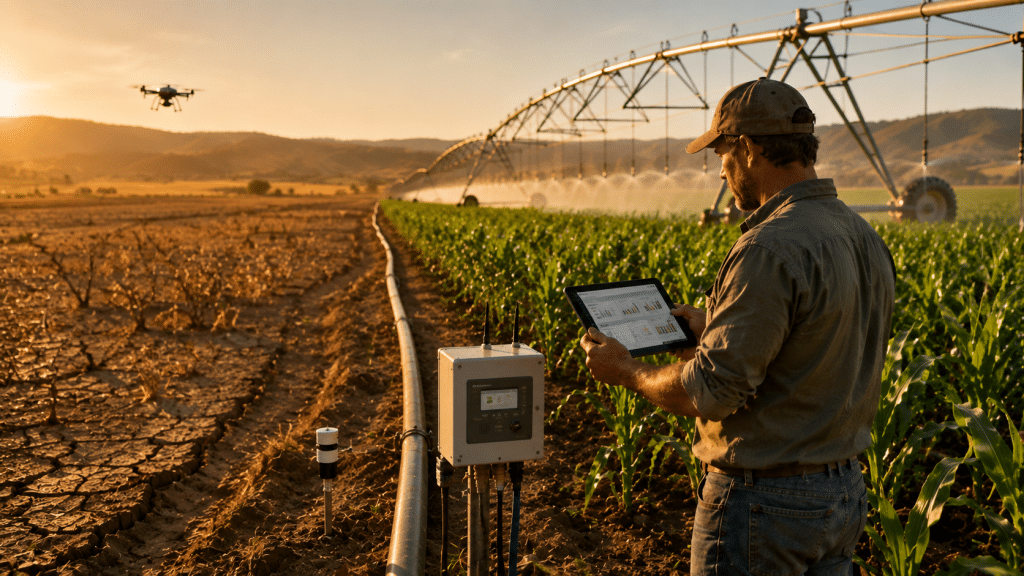
Water has become one of the most valuable resources in modern agriculture, especially in South Africa where drought conditions, rising temperatures, and unpredictable rainfall continue to place enormous pressure on farmers. Across the country, agricultural producers are being forced to rethink how they manage irrigation, conserve water, and maintain crop yields under increasingly difficult conditions. Traditional irrigation methods often waste significant amounts of water, increase electricity costs, and reduce operational efficiency. This is why smart irrigation South Africa is rapidly becoming one of the most important investments for modern farming operations.
Today’s farmers need more than simply access to water. They need precision control, real-time monitoring, and intelligent systems capable of maximising every litre used. Smart irrigation technology is helping agricultural businesses improve water efficiency, reduce operational costs, strengthen drought resilience, and protect long-term profitability. From soil moisture sensors and AI-powered irrigation scheduling to satellite monitoring and automated water management systems, precision irrigation is transforming the future of farming in South Africa.
Why Drought Is a Growing Threat to South African Agriculture
South Africa is one of the world’s water-scarce countries. Many agricultural regions experience recurring drought cycles, unpredictable rainfall patterns, and increasing climate volatility.
For farmers, this creates serious challenges such as:
- Reduced crop yields
- Water restrictions
- Rising irrigation costs
- Soil degradation
- Heat stress on crops
- Increased production risk
Climate change is intensifying these challenges further.
Longer dry periods and more extreme weather conditions are placing additional pressure on already limited water resources.
This makes efficient irrigation more important than ever.
Smart irrigation South Africa provides farmers with the tools needed to adapt to these conditions while maintaining productivity and sustainability.
What Is Smart Irrigation?
Smart irrigation refers to advanced irrigation systems that use real-time data, automation, and precision technology to optimise water usage.
Unlike traditional irrigation methods that operate on fixed schedules, smart irrigation systems continuously adjust watering based on actual field conditions.
These systems commonly use:
- Soil moisture sensors
- Weather monitoring
- Satellite imagery
- AI-powered analytics
- Automated irrigation controllers
- IoT farming devices
- Precision irrigation mapping
The goal is simple: deliver the right amount of water, at the right time, in the right place.
This dramatically improves water efficiency.
How Traditional Irrigation Wastes Water
Traditional irrigation systems often rely on fixed watering schedules that do not account for changing environmental conditions.
This creates several inefficiencies.
Overwatering
Fields may receive water even when soil moisture levels are already sufficient.
This wastes water and increases pumping costs.
Underwatering
In some cases, crops may not receive enough water during periods of high heat stress.
This can reduce yield potential.
Uneven Distribution
Traditional systems may apply water inconsistently across different areas of a field.
Some zones become oversaturated while others remain dry.
Increased Electricity Costs
Excessive pumping increases energy consumption and operational expenses.
Nutrient Leaching
Overwatering can wash valuable nutrients below root zones, reducing fertiliser efficiency.
Smart irrigation South Africa solves many of these problems through real-time precision management.
7 Ways Smart Irrigation Systems Improve Farming Efficiency
1. Soil Moisture Monitoring
One of the biggest advantages of smart irrigation South Africa is accurate soil moisture tracking.
Soil moisture sensors continuously measure water levels within the soil profile.
These sensors provide real-time data about:
- Soil saturation
- Root zone moisture
- Water availability
- Irrigation needs
This allows farmers to irrigate only when necessary.
Benefits of Soil Moisture Monitoring
- Reduced water waste
- Lower pumping costs
- Better crop health
- Improved drought management
- More efficient irrigation scheduling
Instead of guessing when to irrigate, farmers can make data-driven decisions based on actual field conditions.
2. Automated Water Scheduling
Traditional irrigation systems often operate manually or on fixed timers.
Smart irrigation South Africa uses automation to optimise irrigation timing dynamically.
Automated systems can:
- Start irrigation automatically
- Adjust watering duration
- Respond to changing weather conditions
- Prevent unnecessary irrigation cycles
This reduces labour requirements and improves efficiency.
Advantages of Automated Irrigation
- Lower labour costs
- Reduced human error
- More precise water management
- Improved consistency
- Greater operational control
Automation also allows farmers to manage irrigation remotely through smartphones or computer dashboards.
3. AI-Powered Irrigation Decisions
Artificial intelligence is becoming increasingly important in modern agriculture.
AI irrigation systems analyse large volumes of farming data to optimise water usage.
These systems consider factors such as:
- Weather forecasts
- Soil moisture
- Crop growth stages
- Evaporation rates
- Historical field performance
AI-powered smart irrigation South Africa helps farmers apply water more strategically.
Benefits of AI Irrigation
- Better water efficiency
- Improved drought resilience
- Reduced waste
- Higher productivity
- Lower operational costs
AI systems continuously learn and improve irrigation recommendations over time.
4. Weather-Based Irrigation Adjustments
Weather plays a critical role in irrigation management.
Traditional systems often fail to adjust quickly enough to sudden weather changes.
Smart irrigation South Africa integrates real-time weather forecasting into irrigation planning.
Systems can automatically reduce irrigation before rainfall or increase watering during heatwaves.
Weather Integration Benefits
- Prevents unnecessary irrigation
- Conserves water
- Reduces electricity usage
- Improves crop protection
- Enhances operational efficiency
Weather-responsive irrigation helps farms become more adaptable to changing climate conditions.
5. Precision Zone Irrigation
Not all areas within a field require the same amount of water.
Soil type, crop density, elevation, and sunlight exposure can vary significantly across a farm.
Precision irrigation systems divide fields into specific management zones.
Each zone receives customised irrigation based on its unique requirements.
Benefits of Precision Zone Irrigation
- Improved water efficiency
- Better crop uniformity
- Reduced overwatering
- Enhanced yield potential
- Lower operating costs
Variable rate irrigation is becoming one of the most valuable tools in precision agriculture South Africa.
6. Satellite and Drone Monitoring
Satellite imagery and drone technology provide farmers with a powerful overview of crop health and irrigation performance.
These technologies help identify:
- Water stress
- Irrigation failures
- Uneven moisture distribution
- Heat stress zones
- Crop development issues
Smart irrigation South Africa uses this information to improve irrigation precision.
Advantages of Remote Monitoring
- Faster problem detection
- Reduced field inspection time
- Improved irrigation efficiency
- Better crop protection
- More informed decision-making
Farmers can detect irrigation issues long before visible crop damage occurs.
7. Reduced Electricity and Pumping Costs
Electricity costs continue rising across South Africa.
Irrigation pumping represents a major operational expense for many farms.
Smart irrigation systems reduce pumping costs by improving water efficiency and preventing unnecessary irrigation cycles.
How Smart Irrigation Reduces Costs
- Less pumping time
- Reduced water usage
- Better scheduling
- Improved pressure management
- Lower maintenance costs
Over time, these savings can significantly improve farm profitability.
Financial Benefits of Smart Irrigation South Africa
Water efficiency directly affects profitability.
Farmers using smart irrigation South Africa often achieve measurable financial benefits.
Lower Water Costs
Precision irrigation reduces overall water consumption.
Reduced Electricity Expenses
Efficient pumping lowers energy usage.
Better Yield Protection
Improved moisture management protects crops during drought conditions.
Reduced Input Waste
Better water control improves fertiliser efficiency and reduces nutrient loss.
Improved Return on Investment
More efficient operations strengthen long-term profitability.
Although smart irrigation systems require upfront investment, many farmers recover costs through operational savings and improved productivity.
Sustainability and Water Conservation Advantages
Sustainability is becoming increasingly important in modern agriculture.
Smart irrigation South Africa supports environmentally responsible farming by improving resource efficiency.
Reduced Water Waste
Precision irrigation minimises unnecessary water usage.
Improved Soil Health
Balanced moisture levels reduce soil erosion and compaction.
Lower Environmental Impact
Efficient irrigation reduces runoff and nutrient leaching.
Better Climate Adaptation
Smart irrigation improves resilience during drought periods.
Sustainable farming practices also strengthen long-term land productivity.
How Smart Irrigation Improves Crop Health and Yield
Crop performance depends heavily on proper moisture management.
Too much or too little water can reduce plant health and limit productivity.
Smart irrigation South Africa helps maintain optimal growing conditions throughout the season.
Benefits for Crop Health
- Reduced plant stress
- Improved root development
- Better nutrient absorption
- More consistent growth
- Reduced disease risk
Healthy crops are more productive, resilient, and profitable.
Common Misconceptions About Smart Irrigation
Despite its advantages, some farmers remain hesitant about adopting smart irrigation systems.
“Smart Irrigation Is Too Expensive”
Although installation requires investment, operational savings often offset costs over time.
“The Technology Is Too Complex”
Modern systems are designed with user-friendly interfaces that simplify irrigation management.
“Traditional Irrigation Works Fine”
Traditional methods may still function, but they often lack the efficiency required under modern drought conditions.
“Only Large Farms Benefit”
Many smart irrigation systems are scalable and suitable for medium-sized operations as well.
The Future of Precision Irrigation in South Africa
The future of agriculture will depend heavily on water efficiency.
As climate pressures intensify, precision irrigation technologies will become increasingly essential.
Future developments in smart irrigation South Africa may include:
- Fully autonomous irrigation systems
- Advanced AI climate modelling
- Predictive drought analytics
- Integrated farm management platforms
- Machine learning irrigation optimisation
- Real-time crop stress detection
These technologies will continue improving sustainability, productivity, and profitability across the agricultural sector.
Why More Farmers Are Investing in Smart Irrigation
Farmers are increasingly recognising that water management is directly linked to long-term business survival.
Smart irrigation South Africa helps agricultural businesses:
- Reduce operational costs
- Improve water efficiency
- Protect crop yields
- Increase sustainability
- Adapt to climate uncertainty
- Improve long-term profitability
As water scarcity becomes more severe, efficient irrigation will likely become one of the most important competitive advantages in agriculture.
Choosing the Right Precision Irrigation Partner
Implementing smart irrigation successfully requires more than simply installing equipment.
Farmers need systems tailored to their specific operational requirements and environmental conditions.
A trusted precision agriculture partner can help farms:
- Analyse irrigation performance
- Improve water management
- Optimise system efficiency
- Monitor crop health
- Reduce operational waste
- Improve profitability
Local expertise is essential when designing irrigation strategies for South African farming conditions.
Frequently Asked Questions
What is smart irrigation South Africa?
Smart irrigation South Africa refers to advanced irrigation systems that use sensors, automation, weather data, and AI analytics to improve water efficiency in agriculture.
How do smart irrigation systems save water?
These systems irrigate only when necessary based on real-time field conditions, reducing unnecessary water usage.
Can smart irrigation reduce electricity costs?
Yes. More efficient irrigation scheduling reduces pumping time and energy consumption.
What technologies are used in smart irrigation?
Technologies include soil moisture sensors, AI analytics, weather forecasting systems, automated controllers, satellite monitoring, and IoT devices.
Is smart irrigation suitable for smaller farms?
Yes. Many smart irrigation systems are scalable and can be adapted for medium-sized and smaller farming operations.
How does smart irrigation improve drought resilience?
By optimising water usage and reducing waste, smart irrigation helps crops survive dry conditions more effectively.
Conclusion
Water scarcity is becoming one of the defining challenges facing South African agriculture. Rising operational costs, recurring drought conditions, and climate uncertainty are forcing farmers to adopt more efficient and sustainable farming practices.
Smart irrigation South Africa provides farmers with powerful tools to improve water management, reduce waste, lower operational costs, and protect crop yields.
From soil moisture sensors and AI-powered irrigation systems to satellite monitoring and precision zone irrigation, modern irrigation technology is transforming how farms manage water resources.
Farmers who embrace smart irrigation technologies today will be better positioned to survive drought conditions, strengthen profitability, and build more resilient agricultural operations for the future.
Profarm Intelligence helps South African farmers unlock smarter water management through advanced precision irrigation solutions tailored to local farming conditions. Whether your goal is reducing water usage, improving sustainability, protecting yields, or lowering operational costs, smart irrigation technology can help take your farming operation to the next level.